

|
Now that you have beautiful natural stone installed, you can follow a few basic guidelines to ensure that your new natural stone will maintain its beauty and resilience for years to come.
Cleaning Natural Stone Surfaces
Delicate chemical compositions of natural stone like marble may interact with unapproved cleaning agents and may damage your new stone. While granite is very durable and more resistant to acids found in vinegars, lemons, and in some cleaning products, you still must use caution. To sustain the life of your natural stone, it is very important that you only use recommended cleaners.
-DON’T-
Use an all purpose cleaner on your natural stone. If the label doesn’t say it is recommended for granite or marble, don’t use it.
-DO-
Follow the recommendations regarding the care and maintenance to your particular type of natural stone.
-DO-
Use cleaners that are made specifically for the type of stone you have.
Spills
Acidic spills including those from lemonade, orange juice, wine, tomato sauce, and vinegar can etch polished marble. These acids usually don’t damage granite but may cause etching if left unattended for a period of time.
-DON’T-
Let a spill go unattended.
-DO-
Clean up all spills on natural stone as soon as possible.
-DO-
Blot the spill repeatedly; never rub as this will increase the chance of permanent etching on your natural stone surface.
Kitchen Countertops
Here at Custom Granite Design we highly recommend all true granites and other “granites” (stones that are traded as granites, but are not true granites), need to be sealed with a good-quality penetrating (impregnator type) sealer to maintain the glossy finish and smooth surface. These sealers though invisible, must be taken into consideration when caring for your natural stone.
-DON’T-
Use any unapproved cleaners on your natural stone.
While most spray cleaners will not damage your natural stone, they may wreck havoc on your sealer and can cause ugly staining, loss of polish, and dull areas. If the cleaner does not say it is safe for granite or marble don’t use it.
-DO-
Clean your countertops regularly with an approved marble and granite cleaner. More frequent cleaning is advised especially around high use areas.
-DO-
Clean up all spills on natural stone as soon as possible by blotting.
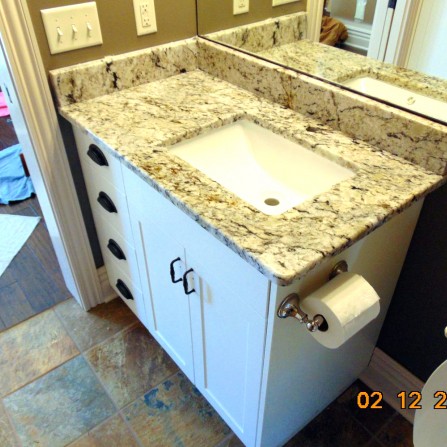
Vanity Tops
Vanity tops are in constant use. To keep your vanity tops in pristine condition, protective care must be taken to ensure that you can enjoy your natural stone for years to come.
Use precaution when cleaning the mirror or other surfaces near your vanity tops. If left unprotected, over-spray or spills onto your natural stone may occur. We recommend covering up your stone while cleaning surfaces near your vanity tops, or only use an all purpose cleaner that is safe for granite or marble.
-DON’T-
Use any cream or powder cleanser on or near your natural stone.
-DON’T-
Store perfume, aftershave, or toothpaste on the surface of your vanity. Instead, keep frequently used items in a tray or other container to prevent spills on your vanity tops.
-DON’T-
Paint your nails or use adhesives near or on your vanity tops.
-DON’T-
Perm or color your hair around your vanity tops.
-DO-
Use cleaners that are safe for granite or marble. If the label doesn’t say it is recommended for granite or marble, don’t use it.
Shower Stall
Showers are an area that demands constant cleaning. This is true whether your shower is made of natural stone or ceramic.
-DON’T-
Use any unapproved cleaners on your natural stone or ceramic.
-DON’T-
Use soap film or mildew removers or cleansers not labeled safe for the type of stone you have installed.
-DON’T-
Use any multi-purpose cream or powder cleanser on or near your natural stone.
-DO-
Use a scrub labeled safe for use on marble or granite. For overall shower maintenance, we recommend using a double sided squeegee. For best results, scrub with the net side and then use the blade to sweep up the excess. Using this method on a daily basis will help keep soap scum from building up.
Floors
Of course you want to keep your granite floors nice and glossy. Just as with other areas made from marble and granite, you must only use products that are recommended for natural stone.
Prior to the first mopping, on a newly installed stone floor, we highly recommend that you hire a professional to deep-clean the floor to remove all possible grout, adhesive, and film after the installation. If you decide not to have this detailing done, do not mop until all the dusty powder from the installation is gone.
-DON’T-
Use a small bucket and sponge mop to clean your natural stone. This will only spread dirty water over the floor instead of cleaning it.
-DO-
Use a cotton loop mop and at least a four gallon bucket. Using the proper buckets and mops is crucial to the successful cleaning of natural stone floors.
-DON’T-
Mop directly after installation. The dust and other fine residual materials will act as abrasives and can damage your floors.
-DO-
Have your floor professionally deep-cleaned or apply the finger test to determine if it is safe to mop. Rub your finger on the floor. If your finger remains clean, it is safe to mop.
-DO-
Use a polish preserver recommended for marble or granite to maintain the “new look” of your floor.
If your floor is in a high traffic area, you may consider using a high-quality floor mat to help protect the gloss of your new stone floor.
Properly maintaining and using only products made specifically for natural stone, will ensure that your finish remains glossy and beautiful for years to come.
|
Granite Custom Design
2369 Heinz Rd, Unit # J, Iowa City, IA 52240
[click here for map]
Toll Free: 1-888-452-0714
Fax: 1-888-661-8983
Monday - Friday 8:00 am – 5:00 pm
Saturday 8:30 am – 12:30 pm
|
|